
Grasshopper Class Spring 1
WELCOME TO GRASSHOPPER CLASS
Happy new year! We are so pleased to see the children back at school and to start the new year. We would like to take this opportunity to inform you about what your child will be learning this term, give you some key dates for your diary and explain the main areas of learning in Year 2 for this half-term.
|
Miss Cubbage |
Mrs Britnell |
English
In English, we follow the storytelling schools’ model (see image below) where children learn to tell stories which help to develop their language and ideas for written stories.

We also have dedicated English sessions and one writing workshop each week. During these sessions, the children will be taught reading and writing skills through a story based around the term’s topic. This term’s story is called ‘Emma Jane's Aeroplane’. The children will be writing and retelling stories and working on expanded noun phrases, co-ordinating clauses and different sentence types. The children will be writing character and setting descriptions as well as deepening their English skills by researching buildings around the world and writing a fact file.
Phonics
At Marlow C of E Infant school, we follow the Essential Letters and Sounds phonics programme. The ELS programme teaches children to read by identifying the phonemes (the smallest unit of sound) and graphemes (written version of the sound) within words and using these to read words. Children experience the joy of books and language whilst rapidly acquiring the skills they need to become fluent independent readers and writers.
In phonics/spelling lessons this term we will be focusing on the following:
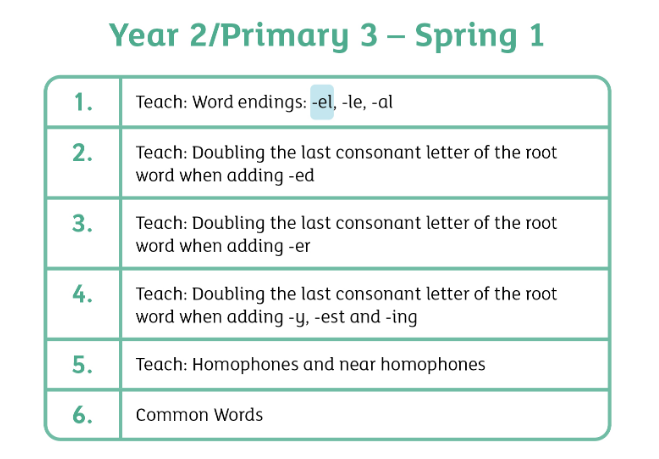
As the children move into Year 2, the emphasis is less on phonics to read and more on using phonics to spell. ELS Essential Spelling uses the code knowledge that the children have learnt in Reception and Year 1 as an approach to spelling. There are 3 lessons of ELS spelling each week.
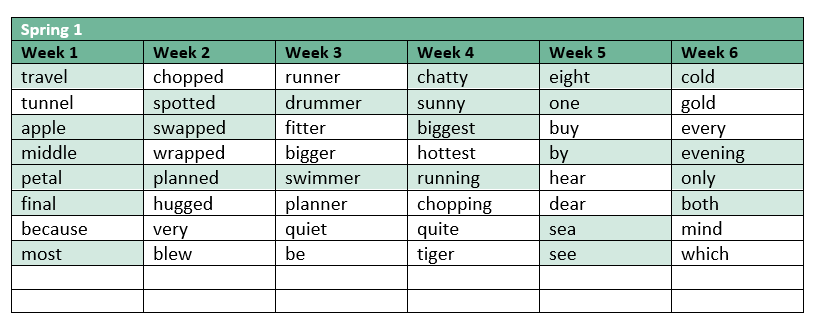
As part of the class' home learning, we will post focus spellings on our Google Classroom every week. These can be practised at home, and we will check the children's learning of spellings each Friday.
The spellings we will focus on this half-term will be the following:
READING
Guided Reading sessions will take place each day. Your child will read with an adult at least once a week. We encourage children to try their best and use their, phonic knowledge when decoding tricky words and answering questions about the text is really important no matter what colour band they are on. We will be covering a range of comprehension activities which will mean that some children will not read out loud with an adult but will focus on delving deeper into a text over a period of weeks. Children will have the opportunity to change their reading books every day so that they can take books home to read.
Reading Record Books These must come into the school every day. They are a vital way for us to communicate with each other about your child’s reading. Any reading you do at home should be recorded in them – this should include your daily reading of a book together, as well as any learning of keywords or sharing of stories. We will write in the book when your child has read in school and the focus for the reading activities. You will then be able to use this focus for your home reading too. As well as using the Reading Record book to write down any reading your child does at home, we would like you to write down some of the reading that is done for pleasure (There is a space at the front of the book for this). This would include the title of the book and what was enjoyed most about the book.
Library day is on Wednesday for Year 2 this term.
HANDWRITING
Children work on handwriting skills daily and in a variety of activities, e.g. through phonic work and writing activities. Exercise books with lines of an appropriate width for the individual child and standard-size pencils are used. Handwriting practice takes place at least three times a week. During the year, cursive joins are practised and children are encouraged to use these in their daily work. Children are encouraged to take pride in the presentation of their work.
Throughout the year there will be continuous development of pattern work, fine and gross motor skills and refining size of letters, and fluency of joined writing. The correct joining patterns will be taught for all spelling patterns taught in phonic sessions. The children will be given an assessment at the beginning and at the end of each term to assess their progress.
This half-term
- Introduce diagonal join to anticlockwise letters: ea
- Practise diagonal join to anticlockwise letters: igh, dg, ng
- Introduce horizontal join to anticlockwise letters: oo, oa
- Practise horizontal join to anticlockwise letters: wa, wo
- Introduce mixed joins for 3 letters: air, ear
- Practise mixed joins for 3 letters: air, ear
- Practise mixed joins for 3 letters: ing
These joins will also be practised in words. By the end of the year, the aim is for the children to be writing using neat cursive handwriting in all areas of the curriculum.
MATHS
We use White Rose Maths in school to support the teaching of maths. White Rose Maths aims to build a whole new culture of deep understanding, confidence and competence in maths – a culture that produces strong, secure learning and real progress.
In Maths this term, there will be a particular emphasis on:
Money
We use White Rose Maths in school to support the teaching of maths. White Rose Maths aims to build a whole new culture of deep understanding, confidence and competence in maths – a culture that produces strong, secure learning and real progress.
In Maths this term, there will be a particular emphasis on:
Multiplication
In this block of learning, children make the connection between repeated addition and multiplication, beginning by recognising and making equal groups. They will then formalise this by using repeated additions to describe pictures and arrays. They will also learn to use this knowledge to draw out problems from given sentences. In Year 2, children are introduced to the multiplication symbols, and they use this knowledge to find answers. Towards the end of this unit, the children will learn to recite the 2, 10 and 5 timetables.
Division
When learning about division, we will experience a range of grouping and sharing activities, building on their previous learning, and they will be reminded of the differences and similarities between these two structures.
We will expose the children to a range of representations to show division. They will use concrete resources, such as base 10, and contextual sentence stems before moving on to using more pictorial and abstract representations, including number lines and number sentences. When working with your child at home, encourage your child to spot patterns to help them complete calculations efficiently.
Length and Height
Children will use and understand the language of length, such as long, longer, short, shorter, tall, taller. Children will be using non-standard units, such as cubes, hands and straws to measure length and height. They should be able to understand that objects can vary in length and size, so a standard unit of measurement is required. Children will measure smaller objects as well as moving on to larger objects using metres. At the end of the term, children will be using comparison skills and symbols to compare length and height.
Computing
The focus of learning in computing this half- term is Computer Science, more specifically coding. The children will:
- explore what an algorithm is and create a computer programme using an algorithm
- create a programme using a given design and understand collision detection
- design an algorithm that follows a timed sequence
- understand that different objects have different attributes
- understand the functions of buttons in a programme
Design and Technology
This half-term children will be designing and making a purse for travelling around the world. They will be investigating fabrics before designing, making, decorating and evaluating their own purse. They will be learning different sewing techniques and stitches to do this.
Geography – Outdoor learning
The Seven continents
This half-term Geography will be taught during outdoor learning. Children will explore the seven wonders of the world. The children will learn the difference between a country and a continent and observe some key human and physical features by studying maps around the world.
Religious Education
Over this half-term, when learning about Christianity, the children will be further developing their understanding of: 'What is the Good News Jesus brings?'. They will learn from passages from the Gospels and how the Bible teaches Christians about the Good News. They will also learn about the links between different types of prayers and the good news that Christians believe Jesus brings.
In addition to this, the children will be identifying why many Jewish people celebrate the festival of Tu B'Shevat. Tu B'Shevat is known as 'The new year for trees' or the Birthday for trees. We will be looking at different commands in the Torah and linking them to the practices of the festival and, in order to be able to follow the commands, Jewish farmers needed to be able to remember how old a tree was. This meant that they would need to remember the ‘birthday’ of the tree. You can find some activities to celebrate Tu B'Shevat to do with the children at home here.
PHYSICAL EDUCATION

In PE this term, the children will be developing their balance and agility skills. Specifically, learning how to jump and land. They will practise both dynamic and static balances on a straight line. They will be working individually, as well as with partners, to develop combinations using shapes, balancing and exchanging objects. Alongside this, children will be working on developing their cognitive cog; performing single skills, movement with some control and performing a small range of skills. In Gym this term, the children will be developing their dance skills, performing solo routines, partner routines and working on artistry by performing a range of moves in a sequence with control and consistency.
Year 2 PE days are Thursday and Friday


PSHE/MIND UP/THINKING SCHOOLS
In PSHE lessons, children will be discussing safety and the changing body. These lessons will focus on secrets and surprises, identifying safe and unsafe touches and discussing privacy. Children will also be discussing the correct vocabulary for body parts.
HOME LEARNING
Guided parental support of learning is an essential part of a good education. It encourages children to become confident and independent in their learning and ensures continuity between the school and home learning environments.
Our Home Learning policy (at the bottom of this page) outlines our approach to home learning, which is based on evidence-based research and is particularly relevant for the age of the children that we teach.
We expect the following activities to be undertaken:
- Daily reading
- Daily practice of Keywords (where relevant)
- Termly science home learning
Other home learning activities, which are optional, include weekly maths and English tasks to support the current in-school learning.
The following activities are posted by teachers or other members of the school team on the Google Classroom for the class:
- Maths tasks
- English task
- Topic based task
From time to time, we will post other activities of interest that the children can complete with their parents at home, such as some to support our Eco work, e.g. 30 Days Wild.
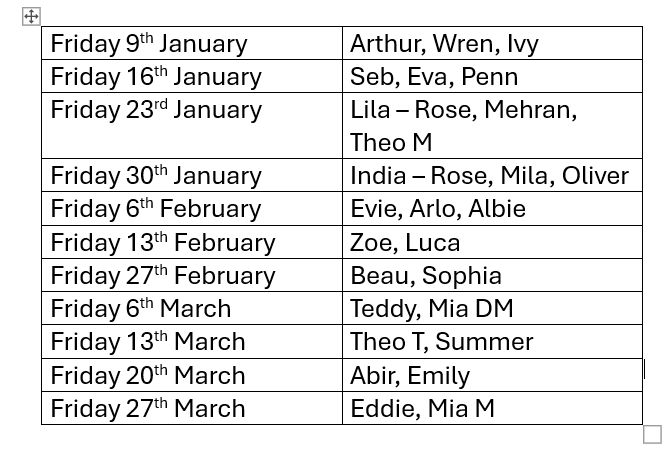
show & tell
For show & tell this half-term, we would like the children to research a famous landmark from around the world. They can draw or make a replica of their chosen landmark, and it would be lovely if they could share some interesting facts.
YEAR 2 DIARY DATES
Tuesday 6th January-Back to school
Monday 12th January-Active Journey week
Thursday 22nd January 9am - Dragonfly class worship
Thursday 29th January 9am - Grasshopper class worship
Friday 13th February - End of half-term
NEXT HALF-TERM
Next half-term, our topic will be 'HEROES'.
ENGLISH
In English, our focus will be around Olympic heroes. We will learn facts and write recounts and, to deepen our learning we will research sporting heroes in our own locality.
MATHS
Our focus will be multiplication and division before moving on to measurement.
WIDER CURRICULUM
Next half-term in Science we will be exploring plants. In RE, we will be thinking about Salvation and in history, we will take a closer look at Marlovian Heroes with a visit from Marlow Museum.
USEFUL WEBSITES AND LINKS

 Home Learning activities: Google classroom on a browser or download the app from your app store

BBC Grammar - https://www.bbc.co.uk/bitesize/topics/zvq9bdm
 Purple Mash https://www.purplemash.com/sch/marlow (to support computing and cross - curricular learning)
 Free access to webinars and advice for parents
  https://nationalcollege.com/enrol/marlow-c-of-e-infant-school